
A universal problem; How to move customers into the top right quadrant and drive long term growth
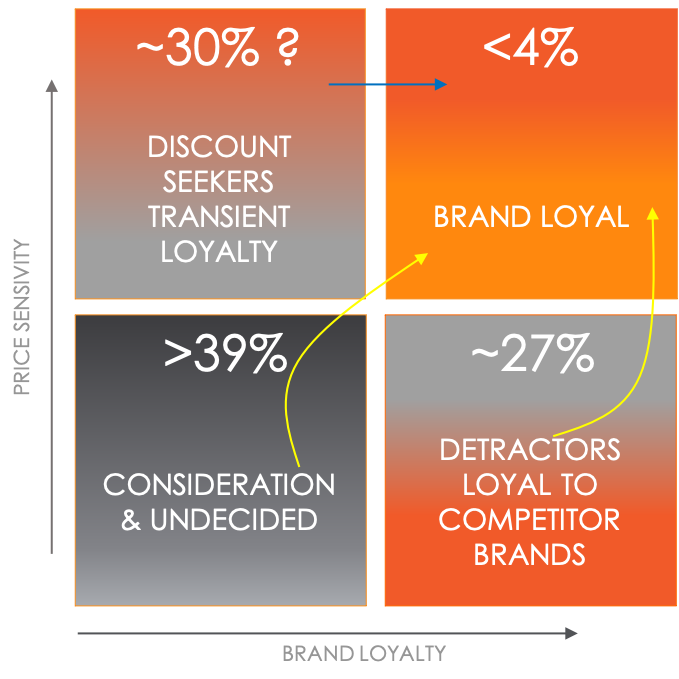
The starting point is a “Know Your Customers (KYC) exercise”, from this create a well constructed value proposition framework, that addresses and caters to all your customer cohorts and demographics.
Within the framework, develop the foundational blocks (e.g., below); this will help convince and shift customer behaviour from the bottom quadrants into the top right quadrant:
A great value proposition, quality product/service, price and after care service.
Well crafted customer experience with customer first principles
For large multi-product businesses, a personalised loyalty management program. For smaller less complex business a customer Lifestage/lifetime value structured CRM program. Remember; new customer acquisitions can cost five times more than retaining an existing customer.
Optimised in-channel User Experience, identify and remove friction.
Read our case studies to see how we have helped clients to grow their customer base and increase profitability.
Alternatively get in touch with us to see how we can help you..
Foundational Principles : Customer Journey Mapping along the Purchase Funnel
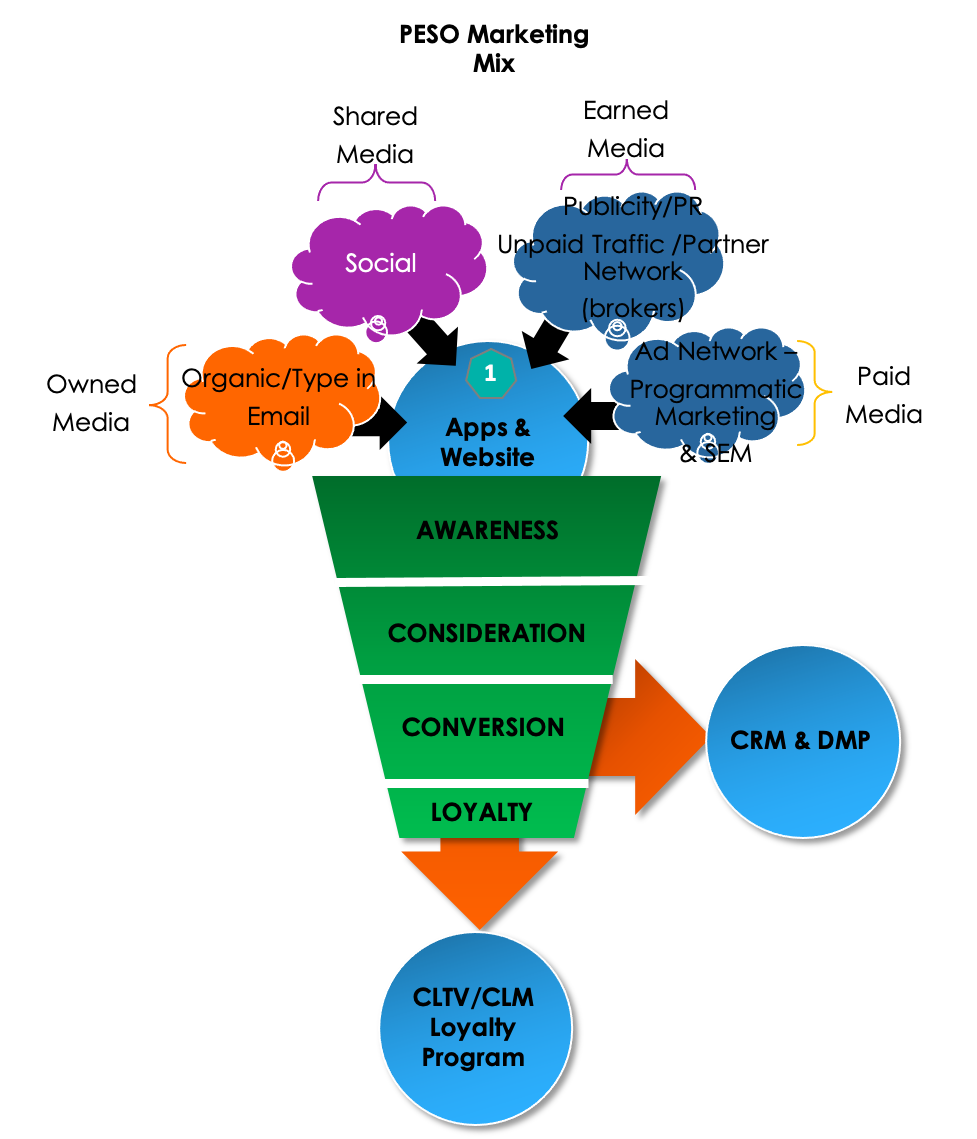
PESO Mix: A significant proportion of an organisations marketing spend is budgeted to driving traffic to their channels and convert them into customers. Putting in place platforms and methods to track this traffic accurately is critical to delivering business goals and deliver effective marketing and ROI/ROAS.
Whilst the conversion funnel concept is reasonably easy to understand, the practicalities of tracking them through this multi-step process can be complex, especially in an omni-channel environment. The reason for highlighting this is to illustrate the costs - for example in the Insurance sector, the CPC can range between $1.00 - $60.00, depending on key word, demand and time. Whilst not every visitor will yield into a real customer, the minimum objective would be to capture some data, preferably PII, so it can be harvested for later use.
At the Awareness stage: a potential customers learns about a brand or product through marketing efforts like social media, ads, or search engine content. Consideration: Consumers research and evaluate their options to see if the product fit their needs. The prospect narrows down their choices and develops a specific desire for a particular product or brand. Conversion: The final step where the consumer makes the purchase decision, often facilitated by a smooth checkout process. CRM & DMP: Becomes a customer, PII, transactional data stored inside data management platform or other data marts. The data can be used to enrol customer onto a structured retention program. Final Stage Loyalty & Advocacy: A post-purchase stage where satisfied customers become repeat buyers. High value customers can become brand advocates.
The tracking, CRO process can be very complex; based on business model, sector, traffic volumes, and the stratification of the PESO Mix. Larger organisations in retail, insurance and eGaming businesses typically use martech platforms to manage and automate some of these processes. These platforms help optimise the customer journey, provide a better customer experience, yielding higher CVR, CRO and cost effective ROI.
Read our case studies to see how we have helped clients to grow their customer base and increase profitability.
Alternatively get in touch with us to see how we can help you..
Using Customer Experience (CX) Framework to drive Customer Lifetime Value (CLTV)
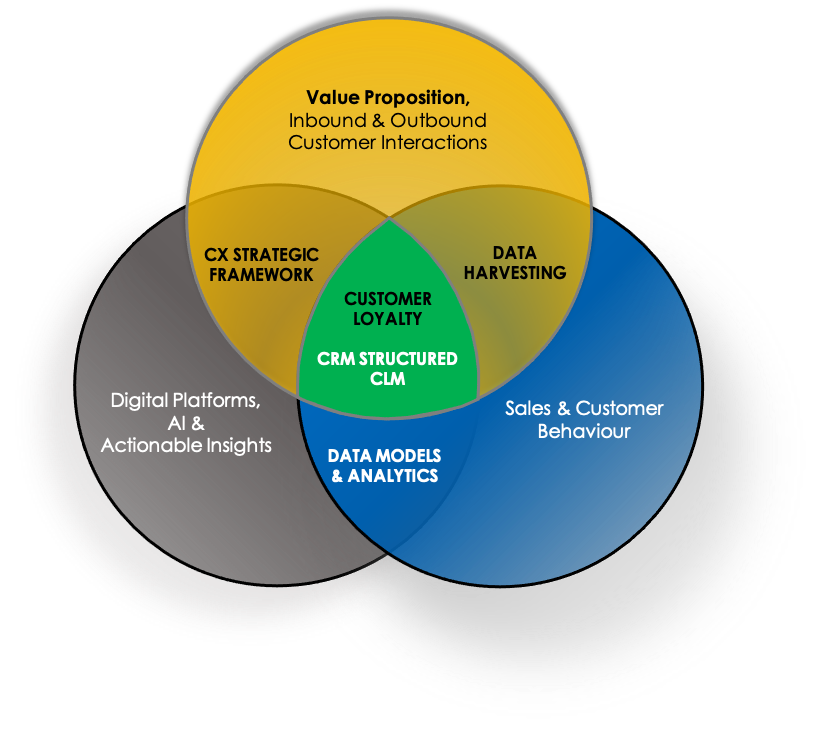
Retaining and managing existing customers at various life stages is always more cost-effective and more profitable to the bottom line, than just relying on new customer acquisitions. A Strategic CX Framework is a key component. At the heart of this is a CLM structured CRM .
These programmes can be large scale; such as Sainsbury's Nectar Programmes, Tesco’s Clubcard, Loyalty Partners etc. Complexity of such programmes depends on the business needs and outcomes, size of customer base, the value proposition, rewards and benefits – such as Key Reason For Belonging (KRB) and competition from competing businesses to name a few.
The programme management, its principles and methods can also be applied to smaller programmes, without adding the complexities and economics that come with a large programme and is suited to smaller businesses.
This is part of the overall CX Framework. Successful frameworks are designed on “Customer First Principles”, here at Foriah, we are strong advocates of this, placing the customer front and centre is key.
CX framework allows businesses to design and deliver optimumservices, identifies the building blocks, technology components toengage with customers, create feedback loops and keep customers engaged rather than on the competition.
A structured and well managed CLM to CRM programme will always deliver profitable results. We can help design and implement these frameworks and activate the programme allowing you to maximise your customer lifetime value and extract higher up the value chain.
Get in touch with us to find out how we can help your organisation.
Customer Lifestage Mapping, an Unified view (360 degree view) & enable Real-Time Personalisation
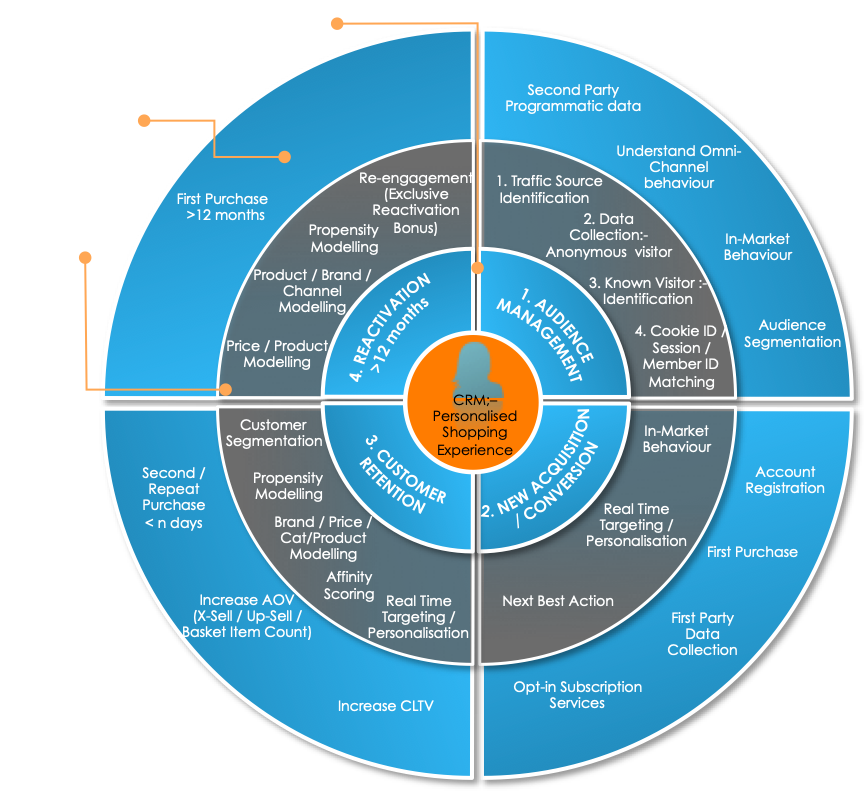
Personalisation is a critical component to a customer centric CRM programme. It helps retention managers to engage with their customers in a more meaningful and relevant way. In return customers are likely to stay engage for longer with tailored and relevant communication. A well designed and executed programme will always allow the business to extract maximum value from this relationship.
A very simplified list of some key components to create and deliver a successful personalisation programme:
• Data Collection; Customer, transactional, non-transactional
• Data Models; Descriptive, Predictive & Prescriptive
• Statistical Models; Centroid, Density, Distribution or Hierarchical models
• Digital Platforms/CX Platforms; to collect, ingest and process structured and unstructured data into actionable insights
• Analytical and Reporting Platform: Cost effective ROI/ROAS
By plugging-in and enabling Machine Learning and AI capabilities, the personalisation programme can become full or semi autonomous, reducing operational & human resource costs. The real-time targeting capabilities also becomes “turbo charged” and highly accurate..
The genesis of digital personalisation especially in eCommerce took root from Amazon, this capability was quickly adopted at an accelerated by the rest of the digital retail industry. Today these principles, methods and technology stacks are industry agnostic and can be applied to most non retail sectors. We have implemented this Insurance, banking (FS) and FMCG, Consumer Goods in Germany, Switzerland, Turkey, Japan and the USA.
Get in touch with us to find out how we can help with your personalisation programme.